


![=]RC[= Hunter’s avatar](https://avatars.steamstatic.com/d8e5d0020443d57bbaa7ce7c8a3588e089519045.jpg)

---
The FPS, as a genre, is in an interesting state right now. Once the flagship of PC performance and cutting edge engine design, it now seems to have collapsed down to an endless series of overblown real-world military scenarios ported from console releases. Sure, there are great titles like Battlefield: Bad Company 2, but they are the exception – and even then, BC2’s still firmly clad in khaki.
Homefront, the next game from Kaos Studios (makers of Frontlines: Fuel of War), could easily have become just another military shooter. However, ever since our first in depth look at the game in an Engine Room back in issue 115 last year, and even more since seeing it in action last year’s E3, we’ve been thinking Homefront’s something different. It really looks like something to look forward to, to actually get excited about without that lingering fear that we’re going to end up with ‘just’ another FPS.
We recently got to have a mess of hands on time with both the singleplayer campaign and Homefront’s multiplayer game, and we’re very happy to say that so far... our expectations have been thoroughly met.
Home is where the war is
Our singleplayer adventure – if that’s the right word for it – began when we woke to someone hammering on the front door of our run down shack. We’d already watched the game’s opening introduction – an extended version of the future history trailer that first got us really excited about the game. So, we knew that most of the USA was occupied Korean territory, and that basically the world had gone to hell in an EMP-blasted handbasket. So that incessant knocking... probably not good.
What it was was even worse. For very little reason we were arrested, hustled into a bus, chained to a seat, and then driven off for some form of re-education. What follows is basically an interactive cut-scene – you can’t move, but you can look around. It’s worth it, too, as this is your first impactful look at what’s become of America.
It’s not pretty.
The local population – the game starts in Colorado, and the entire area is ringed by mountain ranges, always visible over the roofs and buildings of all the early levels – are under the gun, literally. Armed squads of Korean soldiers patrol the streets, and dissidents and malcontents are being rounded up. In extreme cases, folks are being put up against the wall and shot – often with family members looking on. Elsewhere, soldiers are dumping bodies in canals and sewers.
A very pretty occupation
It is a bloody and brutal introduction, perhaps a touch over the top in terms “Hey, look, these are the badguys”, but it sets the tone wonderfully. Even more important, it shows off the nature and mood of future America – everything’s worn and shabby, pocked with bullet marks or stained by the elements. This is clearly a place where the usual rhythms of civic responsibility have utterly broken down.
But for all that, it’s also still a very colourful place, which is more a testament to Kaos Studio’s efforts with the Unreal Engine. Unreal’s always been capable of putting out a lot of vibrant colours, but that’s something that many devs shy away from when making a modern shooter – if it’s not brown or green, it’s usually not worth wasting polygons on.
Homefront, however, is not really a military shooter, not at least in the singleplayer. It’s about a civilian resistance fighting in civilian locations. You’ve got bright posters and billboards, a deep blue sky above, and all the other colours you’d expect to see – even on the freedom fighters themselves. It’s actually quite striking how colourful it all is, which only makes the grim content itself that much more striking.
You’re in the resistance, now
Back to our bus-ride, and it’s not too long before our trip to a labour camp – or worse – is interrupted.
By a truck totalling the bus!
It turns out that the local resistance cell needs a pilot, you’re it. Again, the form of the rescue serves to reinforce the fact that the people you’re fighting alongside are not military, and nor are you. It’s a slipshod affair that swings between hiding from patrols and balls-to-the-wall firefights.
You’ll also find yourself swapping between weapons a whole lot, and that’s another conscious decision the devs took for this part of the game. Ammo is pretty thin on the ground, so you’ll always be scrounging from enemies or hidden supply caches. You at least, for the first few missions, rarely fight alone; it’s possible to re-stock items like grenades from other team members once you’re fully equipped.
And speaking of combat, it’s pretty brutal. The game uses the now classic regenerative health system first made popular by Halo; take a few rounds and screen goes all red and dramatic until you take cover and recover your breath. Your Korean opponents, though, can be dropped with a single well-placed shot. The combination of gritty ballistics and regen is a solid one, and with some fights featuring multiple waves of badguys from different directions, the sense of chaotic conflict between conscript troops and resistance members is well captured.
Of course, some soldiers are more armoured than others, so it pays to go for those headshots. Death animations are suitably gory and feature some impressive rag-dolling, especially when you let fly with a well-cooked off grenade.
But it’s the story elements of the game that stick with you, and game’s pacing is designed to give you a lot of moments of reflection in between all-out firefights. It’s at these moments that you can appreciate not only the sheer detail of the world, but also little things like the game soundtrack, and effort put into achieving a ray of dappled sunlight breaking through the branches of a tree.
There is every chance that Homefront’s campaign could be the singular singleplayer FPS experience of the year.
Listen up, soldier!
Homefront’s multiplayer takes a very different approach, and it’s one that’s pretty unique. It’s almost a completely different game – you take on the roll of trained soldiers in the frontline conflicts that lead up to the annexation, not freedom fighters. A lot of modern games feel like the singleplayer experience is merely a training level for the more popular online play, but Homefront makes the two experiences two very different beasts, and tricks learned in one part of the game won’t necessarily move across to the other.
For instance, even your movement rate is different in multiplayer. As a soldier trained to cross a battlefield, you can move much faster. Just this simple difference changes the feel drastically, but as speed is often of the essence in modern FPS multiplayer games (whether to get to objectives or simply get across ever-growing maps), it serves a practical purpose too.
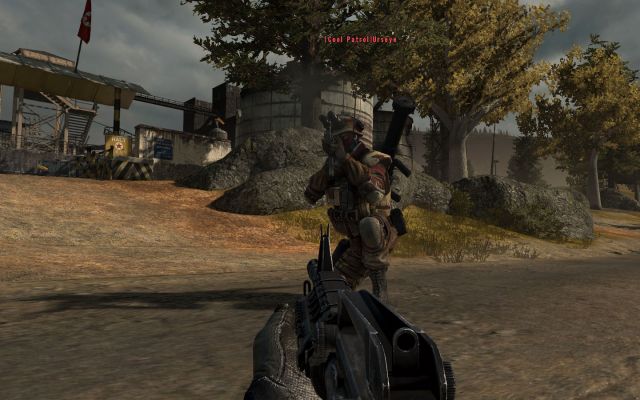
At a separate hands-on event to our singleplayer session, we got to play two of the game’s modes. One was a simple objective-based mission that would be instantly familiar to any veteran of Battlefield: Bad Company 2 – there were three objectives, and once held for a time, another set of objectives unlocks and the action moves along the map. We played two different maps with this mode – one that ran along a main highway with a number of overpasses and a mess of wrecked vehicles, and another that was on rolling farmland and much more open.
The other mode we played was called Mission Commander, and in this an AI ‘commander’ observes the ongoing carnage and hands out missions to different players. These missions are either take and hold this spot, or take out player X – based on how well certain players are going.
It’s kind of like Red Dead Redemption’s multiplayer, where your notoriety is both a bragging point, and a huge shiny beacon to other players to come kill you. It also works really well in a more pure FPS, both rewarding good players, while also providing a fluid focus to the gameplay.
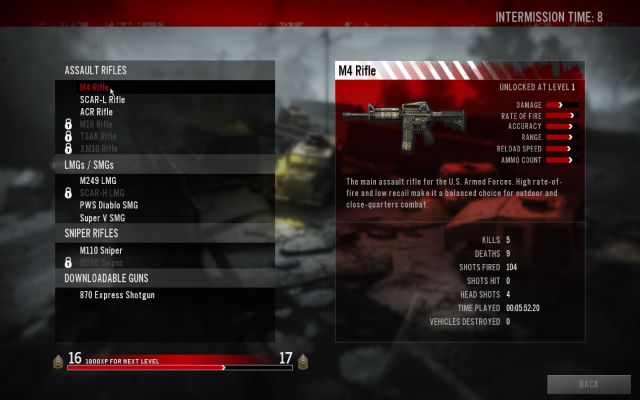
All the game modes feature a class-based load out, and weapon unlocks based on constant levelling. The classes are Assault, Heavy, SMG, Sniper, Stealth and... something else. We mostly played Sniper and Assault, and with many of the classes having access to drones to either scout the terrain or remotely assault positions, there’s a mess of different gameplay types on offer.
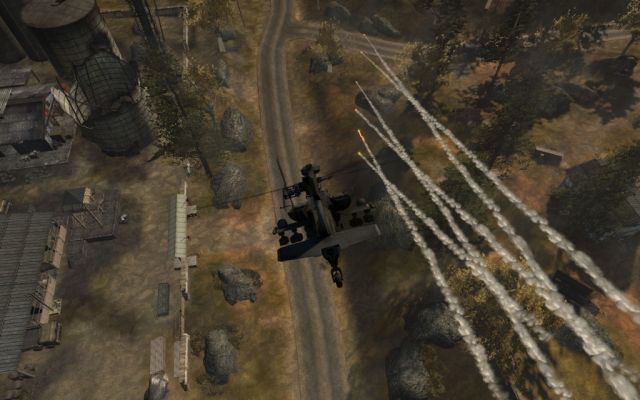
Over all of these systems, which would be familiar to any Call of Duty fan, is the Battle Point mechanic. This is essentially an in-game currency that you can use to activate secondary weapons, like rocket launchers, or to spawn a vehicle, ranging from a HUMV to an attack helicopter. This is kinda cool, as it leads to somewhat of an arms race as people gather BP through taking objectives and kills. There’s also that constant choice – spawn a lesser vehicle as soon as you can, or hoard points for a larger, tougher tank or similar.
Once very neat function in the game’s spawning system is that you can choose to spawn into an empty position on a friendly vehicle – no more madly running after armour trying to hop on for a ride!
Taken all together, Homefront’s multiplayer offering is a much more conventional game than its singleplayer, but it’s still an awful lot of fun. The range of classes, the addition of mobile drones, and of course heavy vehicles and fluid objectives all make for an interesting take on modern military FOS combat. We don’t think it’s as strong an offering as the campaign, but it’s still very good.
Almost done
According to Kaos Studios, the game is very much complete, and simply going through the optimisation and bug-fixing stages. It’s certainly feeling finished, and given that we previewed the game on Xbox 360, we have high hopes for Homefront on PC. We’ve been told, straight from a Kaos dev, that it absolutely blows the console version away – given how tightlipped most devs are when you ask them about PC conversions, we can only hope this is a good sign for our favourite platform.
Questions of ports and platforms aside, though, even on console Homefront is an amazing experience. We had folks from all over the office watching us play – even non-gamer’s were fascinated by the game’s storyline and setting. It’s that rare FPS that’s both emotive and fun and exciting.
And that describes us pretty well – we’re very excited about Homefront, and as long as the PC Gods are smiling, this is going to be one helluva a package.
Review written by:
atomic mpc Australia




![=]RC[= BooZer’s avatar](https://avatars.steamstatic.com/a9c7573d8498c6a4a562e117285b86bfcdd81144.jpg)
 Als Battlefieldler muss man sich daran mitunter natürlich erst gewöhnen - sofern man es denn kann ...